
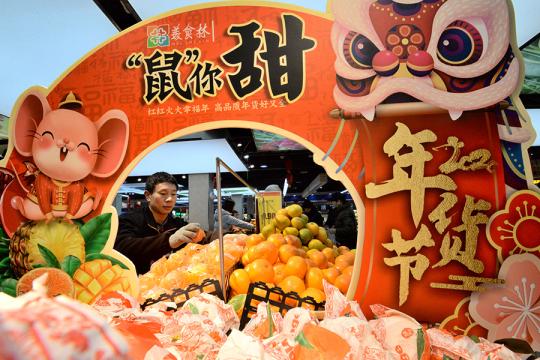
A salesman sorts fruit at a supermarket in Handan, Hebei Province. (Photo by Hao Qunying/for China Daily)
Easing consumer prices, improving industrial activity keep momentum on an even keel
Inflation pressure has started abating in China and could remain subdued for the rest of the year as consumer prices, led by pork, have started softening since last month, analysts said on Thursday.
China's consumer price index, a main gauge of inflation, rose by 4.5 percent year-on-year in December, the same as the previous month, breaking a three-month streak of rising consumer inflation, the National Bureau of Statistics said on Thursday.
The country's whole-year CPI came in at 2.9 percent, well within the government-stipulated target of 3 percent, according to the NBS.
The CPI stabilized last month as food prices rose at a slower pace of 17.4 percent, compared with 19.1 percent in November, the NBS said. The year-on-year rise in pork prices, which accounted for nearly half of the headline CPI growth, eased to 97 percent in December from November's 110.2 percent.
"With positive changes in hog production, the release of pork reserves from central and local levels into the market, and the rise in pork imports, concerns about tight pork supplies have further eased," said Shen Yun, a senior statistician with the NBS.
Nonfood prices gained 1.3 percent year-on-year last month, up from 1 percent in November, as prices of services such as medical care and education rose, said Shen.
On a monthly basis, the CPI remained flat last month, versus a 0.4 percent rise in November, as pork prices dropped by 5.6 percent from a month earlier, the bureau said.
Zhang Deli, chief macroeconomic analyst with Guangdong province-based Yuekai Securities, said that the concerns about spikes in consumer prices due to a shortfall in pork supplies are fading, as the nation has ramped up hog production steadily.
China's stock of breeding sows rose for the third consecutive month in December, up by 2.2 percent from November, the Ministry of Agriculture and Rural Affairs said on Wednesday.
"The CPI may peak in January because of strong demand for pork during Spring Festival and a low basis last year, but then decline gradually," Zhang said.
Tensions between the United States and Iran may push up crude oil prices and therefore the overall prices, yet only temporarily, Zhang said.
Steven Zhang, chief economist with Morgan Stanley Huaxin Securities, said that if the US-Iran tensions cause a continuous tightening of global crude oil supplies, inflationary pressures may increase in China.
The possible disruptions from pork and oil on overall prices, however, are unlikely to change this year's focus of monetary policy from stabilizing economic growth to tempering inflation, he said.
The NBS data showed that the rise in core CPI, which excludes food and energy prices, remained low at 1.4 percent year-on-year in December, unchanged from a month earlier, indicating sluggish domestic demand.
To reduce financing costs for the real economy, China's central bank may cut required bank reserves another two or three times this year, and the loan prime rate-the new benchmark lending interest rate-may see further drops, he said.
The producer price index, which gauges factory gate prices, dropped by 0.5 percent year-on-year last month, versus a 1.4 percent decrease in November, pointing to more industrial activity, NBS data said. For the whole of 2019, the PPI edged down by 0.3 percent.
Li Xiang contributed to this story.